
Profile
Overview
- Location: North Umpqua River, Umpqua National Forest, Douglas County, off the North Umpqua Highway (OR-138)
- Waterfall Type: Plunge (two tiers)
- Height: About 113–120 feet in two tiers. Sources vary: the Forest Service gives 40 + 80 feet, while Adam Sawyer gives 28 + 85 feet.
- Elevation: About 2,400 feet at the viewing platform
- Trail Distance: 0.4 miles each way (0.8 miles round trip), with nearly 200 steps and about 165 feet of elevation gain; about 30 minutes
- Trailhead GPS: N43 15.842′ / W122 25.646′
- Difficulty: Easy, but the stairs make it feel harder than the distance suggests
- Best Time to Visit: Late spring through fall; the falls run year-round
- Also see: Watson Falls, about 2 miles east, one of the tallest waterfalls in Oregon
History & Background
Toketee Falls is the signature waterfall of the North Umpqua Highway, and one of the most photographed in Oregon. The river squeezes through a narrow notch, drops into a hidden basin, and then plunges about 80 feet into an emerald pool framed on both sides by columns of dark basalt. From the viewing platform the whole scene looks almost designed, which is exactly what the name describes.
The name became official in 1916, when the U.S. Board on Geographic Names chose Toketee Falls over two other names in local use, Ireland Falls and Toketie Falls.
What Does “Toketee” Mean?
Toketee comes from Chinook Jargon (also called Chinuk Wawa), the trade language once spoken across the Pacific Northwest by Native peoples, fur traders and settlers. The word is usually translated as “pretty” or “graceful.” It’s pronounced TOKE-uh-tee.
Chinook Jargon words are scattered across Northwest place names, and many of them, like this one, describe what early travelers saw. Few fit better than Toketee: the falls are not the tallest or the most powerful in the region, but their symmetry and setting make them some of the most graceful.
The Wooden Pipeline
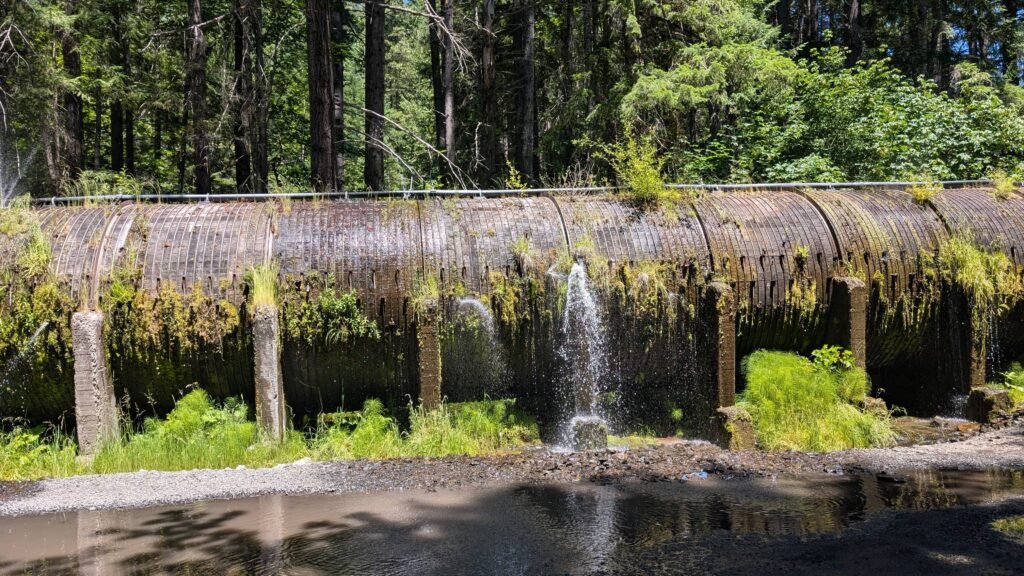
The first thing you see at the trailhead isn’t the waterfall; it’s a huge wooden pipe. This 12-foot-wide redwood-stave flowline is part of the Toketee development of PacifiCorp’s North Umpqua Hydroelectric Project. Completed in December 1949, it was the first piece of the project to be built.
Water leaves a small reservoir (Toketee Lake) behind an earth-fill dam just upstream, runs through about 1,500 feet of wooden pipe, then through a tunnel under Deer Leap Rock to a powerhouse with three turbines. According to the interpretive marker at the site, the plant generates about 45 megawatts, enough for roughly 22,500 homes. The project helped electrify Douglas County after World War II, and the marker notes it is eligible for the National Register of Historic Places.
The old pipe leaks, and on a hot day the spray along the trailhead is a welcome cool-down. The diversion also changed the falls: before 1949, the full North Umpqua poured over Toketee, and it was far more powerful in the rainy season. Today the flow is regulated, so the falls look much the same in every season.
Geology
Toketee Falls is carved into a thick lava flow that cooled into columnar basalt. As lava cools slowly, it shrinks and cracks into long, many-sided columns, the same process that created the famous columns at Devil’s Postpile and Giant’s Causeway. At Toketee the river has cut straight through the flow, leaving the columns standing like organ pipes on both sides of the falls.
The lava came from the High Cascades near Mount Bailey, the peak above Diamond Lake. Sources disagree on its age: the interpretive marker gives roughly 25,000 to 125,000 years, while other sources put the flows at around three-quarters of a million years. David L. Anderson’s guide links it to an early eruption of Mount Mazama, the volcano that later collapsed to form Crater Lake. Either way, it is young rock by geologic standards.
Gregory Plumb’s Waterfall Lover’s Guide points to the other half of the story: where hard basalt sits on top of weaker rock, the weak layer erodes faster and undercuts the cliff, keeping the drop sharp and vertical. Toketee is one of his examples of a waterfall shaped this way.
Above the falls, the river runs through a narrow gorge of potholes, round hollows ground into the bedrock by rocks and gravel spinning in eddies. The marker calls these loose rocks “grinders”: they wear the hollows deeper, while fine sand polishes the rock smooth. The upper tier of the falls is partly hidden in this slot, which is why the view from the platform shows mainly the lower plunge.
Directions & Access
- Nearest City: Roseburg, about 60 miles west. Diamond Lake is about 20 miles east.
Getting there from Roseburg: Take OR-138 (Diamond Lake Boulevard) east through Glide and up the North Umpqua canyon. At milepost 58.6, turn north onto Forest Road 34 (Toketee-Rigdon Road). Cross the first bridge and turn left into the trailhead parking lot. The drive east of Glide passes through the burn area of the 2020 Archie Creek Fire.
Getting there from Crater Lake or Diamond Lake: Take OR-138 west past Diamond Lake and the Lemolo turnoff to milepost 58.6, then turn right onto Forest Road 34.
The Trail
The trail (#1495) starts at the far end of the parking lot, next to the wooden pipeline. It follows the edge of the North Umpqua canyon for 0.4 miles, passing views down into the gorge before ending at a sturdy viewing platform built around two Douglas firs and a yew tree. Along the way the trail passes through tall Douglas fir, hemlock and western red cedar, and meets the river where it tumbles through a jumble of big boulders before entering the gorge. The path is short but uneven, with roots, rocks and nearly 200 steps in several long flights (the historical marker counts 97 up and 125 down). There’s a bench about halfway.
- Parking: We didn’t see a fee posted when we visited, but we hang our Northwest Forest Pass just in case. Some older guidebooks list it as required. It’s busy on summer weekends, but the hike is short, so spaces turn over quickly.
- Facilities: Restrooms, picnic area and interpretive signs at the trailhead. No drinking water.
- Dogs: Allowed on leash.
- Accessibility: Not wheelchair accessible because of the stairs.
The platform view is the classic one, though Adam Sawyer calls it “frustratingly distant.” A zoom lens helps for photos.
Stay behind the fence. A fence at the platform blocks the steep slope down to the pool, but people still climb over it, sometimes using ropes left by others. The Forest Service reports multiple serious injuries and deaths at Toketee over the years. The best view of the falls is from the platform anyway.
Best Time to Visit
- Spring: Green canyon walls and fresh moss. Because the river is regulated by the dam upstream, the falls don’t swell much with snowmelt.
- Summer: Dry trail, long days and the most visitors. Come early or late for a quieter platform and softer light on the pool.
- Fall: Fewer crowds, and vine maple adds splashes of red and yellow under the conifers. A good time to combine Toketee with Watson Falls and Umpqua Hot Springs.
- Winter: At 2,400 feet, the trailhead can get snow and the steps can ice over. Check road conditions on OR-138 before you go.
Nearby Attractions
- Watson Falls: about 2 miles east on OR-138, a 293-foot plunge on a short, steep trail.
- Warm Springs Falls: a 60-foot curtain over columnar basalt on an easy forest walk near Toketee.
- Whitehorse Falls and Clearwater Falls: two easy roadside stops on the Clearwater River farther east on OR-138.
- Lemolo Falls: the tallest falls on the North Umpqua River, near Lemolo Lake.
- Fall Creek Falls: a two-tiered falls off OR-138 farther west near Idleyld Park.
- Umpqua Hot Springs: a popular hillside hot spring up Forest Road 34. Check the Umpqua National Forest’s current rules before you go.
- Toketee Lake: the small reservoir behind the dam, with a campground just up Forest Road 34.
- Diamond Lake and Crater Lake National Park: to the east on OR-138.
References
- Links:
- Books:
- Hiking Waterfalls Oregon by Adam Sawyer: hike #56. Main drop 85 ft, upper drop 28 ft; 0.8 mile round trip with 165 ft of gain; trailhead GPS N43 15.842′ / W122 25.646′.
- Waterfall Lover’s Guide: Pacific Northwest by Gregory Alan Plumb: a 30-foot drop followed by a 90-foot plunge; describes the redwood-stave pipeline and Toketee Powerhouse.
- Waterfalls of the Pacific Northwest by David L. Anderson: lists the height as 90 feet with large volume; ties the basalt to an early Mount Mazama eruption.
Photos
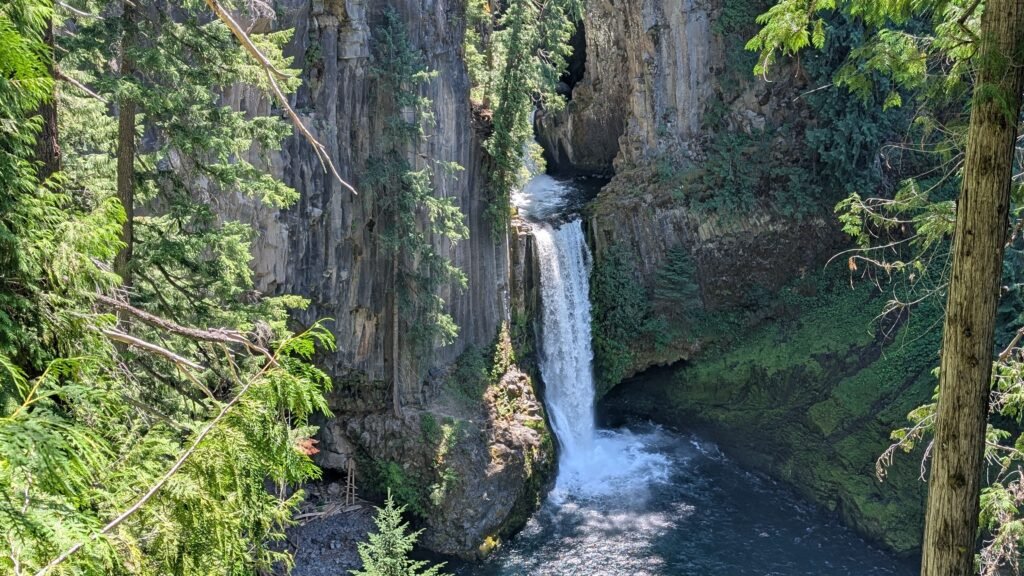
Toketee Falls
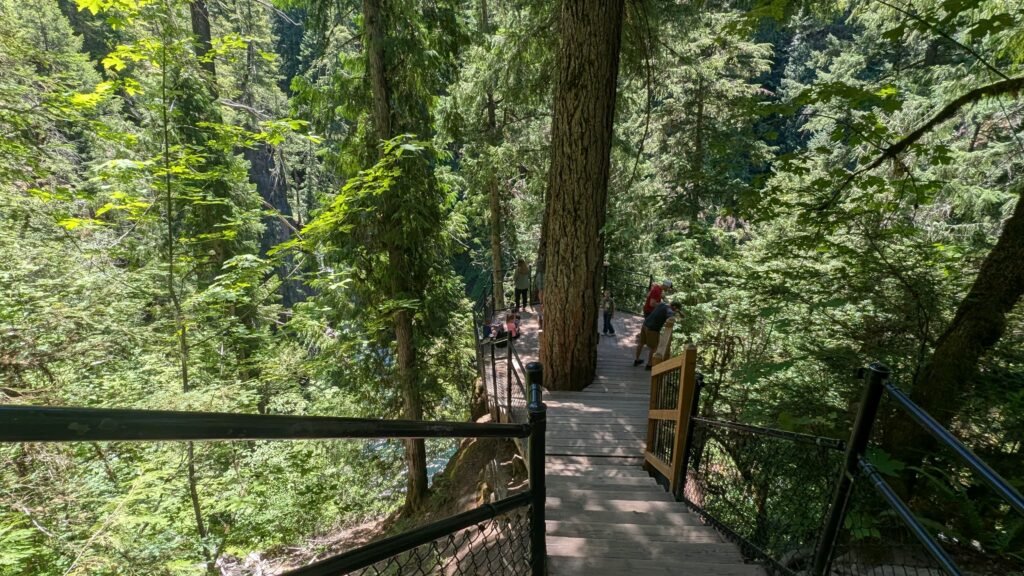
Toketee Viewing Platform
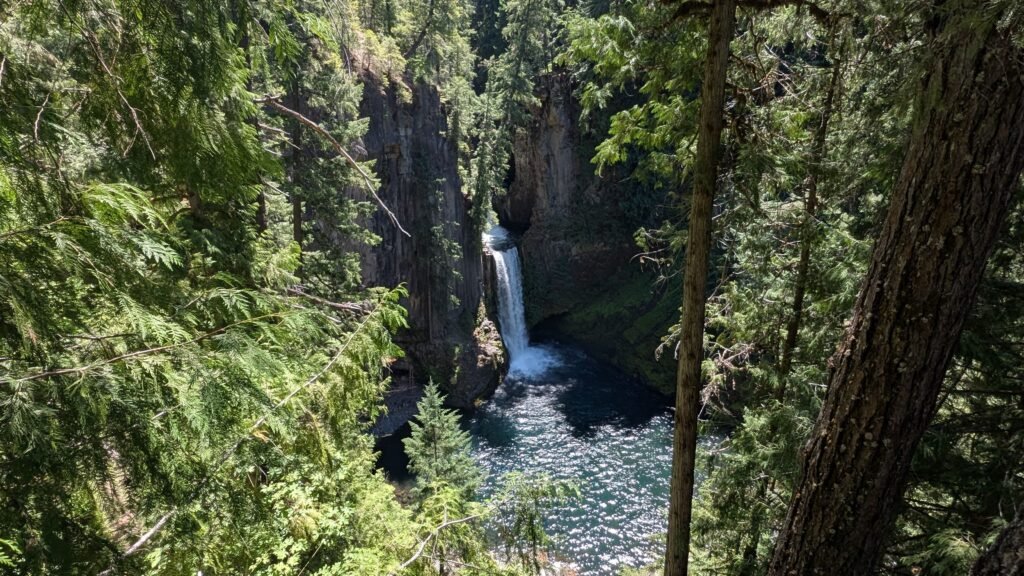
Toketee Falls from Far Away
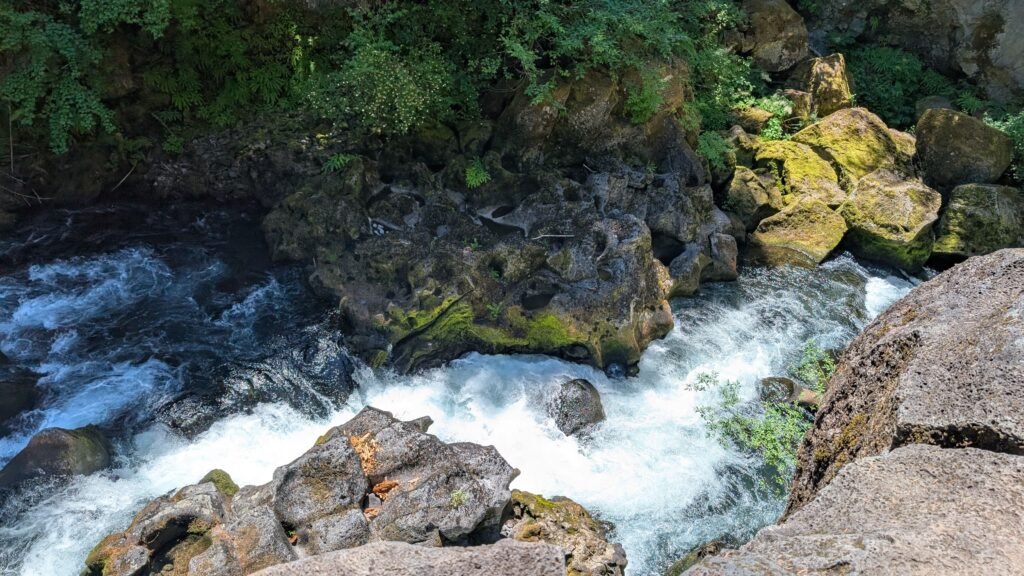
North Umpqua River on Hike
Wooden Pipeline at Toketee Falls Trailhead
Map
Sorry, no records were found. Please adjust your search criteria and try again.
Sorry, unable to load the Maps API.