
Profile
Overview
- Location: Salt Creek, Willamette National Forest, Lane County, just off OR-58 about 5 miles west of Willamette Pass
- Waterfall Type: Plunge
- Height: 286 feet
- Elevation: About 4,000 feet at the top of the falls
- Trail Distance: About 50 yards from the parking lot to the accessible viewing platform. About 0.5 miles one way on a steep trail to the lower viewpoint. Optional 3.4-mile loop to Diamond Creek Falls.
- Difficulty: Easy to the platform; moderate on the stairs down to the lower viewpoint
- Best Time to Visit: Late spring through early fall. The site is normally closed in winter.
- Fee: $5 per vehicle day-use fee, or a Northwest Forest Pass
- Also see: Diamond Creek Falls, a 120-foot fan on the loop trail from the same parking lot
History & Background
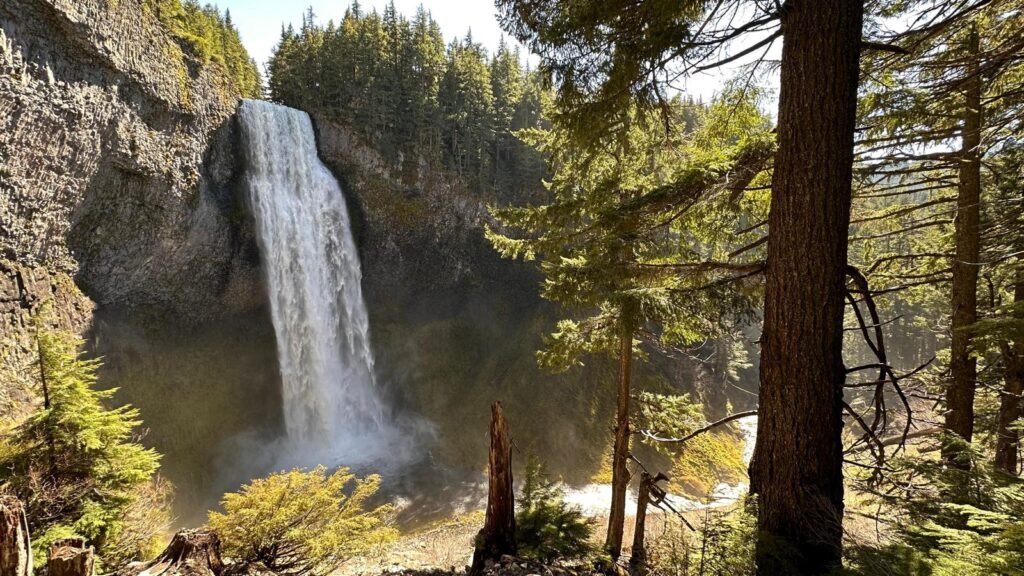
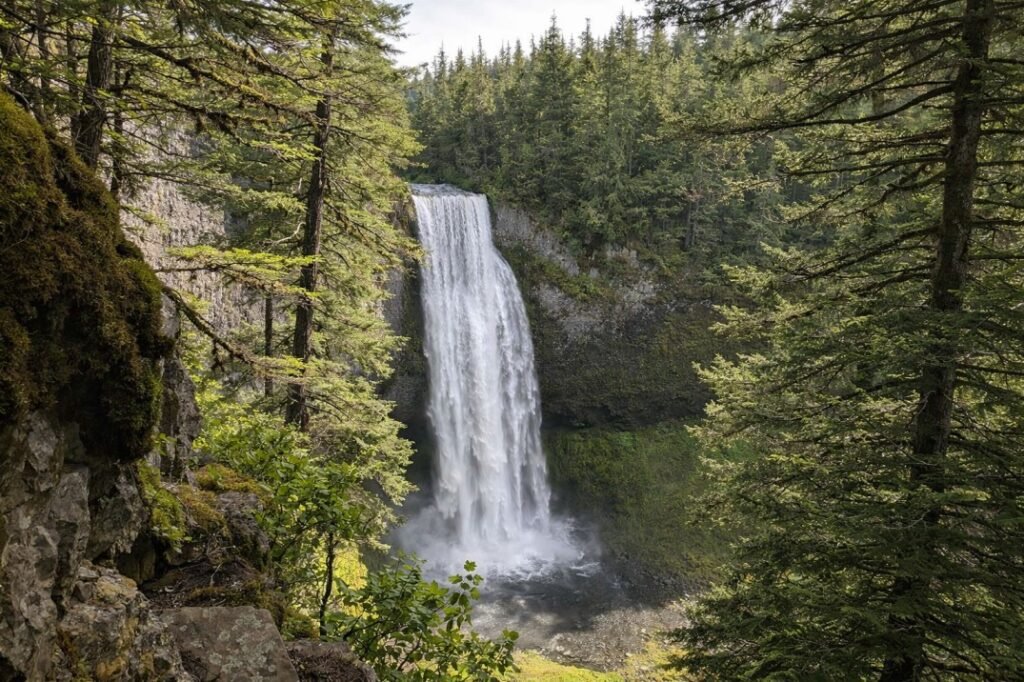
Salt Creek Falls is one of the easiest big waterfalls in Oregon to see, and one of the easiest to miss. Highway 58 runs right past it, but the creek drops into a canyon below the road, so most drivers headed over Willamette Pass have no idea that one of the state’s tallest waterfalls is a few hundred feet away. Pull off at the sign, and you can be looking down a 286-foot drop within a minute of parking.
Lists of Oregon’s tallest waterfalls vary depending on how you measure. Salt Creek Falls is often called the state’s second-tallest single drop, though some rankings put Watson Falls ahead of it. Either way, few Oregon waterfalls this size come with this much water. David L. Anderson’s guide notes that what it lacks in height compared with Multnomah Falls, it makes up for in volume.
The falls and creek are named for nearby salty springs that wildlife use as mineral licks. The first recorded sighting by non-Native explorers came in March 1887, when Frank S. Warner and Charles Tufti reported the falls. Tufti, of Molala ancestry, lived at the Warm Springs Agency.
Today the falls sit in the Middle Fork Ranger District of the Willamette National Forest. The Forest Service maintains an observation site with picnic tables, interpretive signs, a rim trail and a viewing platform designed so wheelchair users can see over the railings.
Geology
Salt Creek Falls is a product of ice and fire. During the last ice age, glaciers covered this part of the Cascades. As they melted back, meltwater from the lakes upstream carved a deep valley. Later lava flows partly filled that valley, and as the basalt cooled it left the hard, dark walls you see around the falls today.
Salt Creek now pours over the edge of that resistant basalt into a gorge it has been cutting ever since. Look closely at the canyon walls from the platform and you can see the columns and layers of these flows. In the same few square miles, Diamond Creek and Fall Creek tumble over the same volcanic rock, which is why this small corner of the forest has so many big waterfalls.
Directions & Access
- Nearest City: Oakridge, about 21 miles west. Eugene is about 60 miles west.
From Oakridge or Eugene: Drive east on OR-58 (the Willamette Highway). About 1 mile past the highway tunnel, just east of milepost 58, turn right at the Salt Creek Falls sign onto Forest Road 5893 and follow it down to the large parking area.
From Central Oregon: Take OR-58 west over Willamette Pass. The turnoff is about 5 miles past the pass, on the left.
Parking, Fees and Facilities
- Parking: A large paved lot at the observation site. Don’t park on the highway shoulder.
- Fee: $5 per vehicle, or display a Northwest Forest Pass (or another Recreation Pass the Forest Service accepts).
- Facilities: Picnic tables and interpretive signs. The Forest Service lists restrooms at the adjacent Salt Creek Sno-Park lot. No drinking water.
- Accessibility: The observation platform is about 50 yards from the lot and is wheelchair accessible. The trail to the lower viewpoint has many stairs and is not.
The Trails
Viewing platform: Walk past the interpretive kiosk to the fenced overlook on the canyon rim. This is the classic view straight down the length of the falls, and for many visitors it’s all they need.
Lower viewpoint: For the full height of the falls, take the steep trail that starts beside the platform. It switchbacks down below the highway through Douglas fir and vine maple, with glimpses of the falls along the way, and ends about half a mile later at a viewpoint opposite the falls, above the plunge pool. Bring a jacket and protect your camera: wind from the falling water swirls off the cliffs and blows spray straight at this viewpoint.
Diamond Creek Falls loop: From the parking area, walk upstream on the paved path, cross Salt Creek on a footbridge, and turn right at the first junction. The trail follows the canyon rim past Too Much Bear Lake and several viewpoints, through rhododendrons that bloom in May and June. After about 1.4 miles, a steep side trail drops to the base of 120-foot Diamond Creek Falls, where you can often rock-hop close in summer. Return on the main trail for a 3.4-mile loop with about 400 feet of gain. Strong hikers can extend it to a 6-mile semi-loop that climbs to Fall Creek Falls.
Our Visit
We stopped at Salt Creek Falls in May 2024, and it was as easy as a waterfall this size gets: a big parking lot, a short level walk to the platform, and a view straight down the drop. If you want the better view, the trail to the lower viewpoint is worth the climb back up. Our main takeaway: you’d hardly know one of Oregon’s largest waterfalls is just off the highway, so don’t drive past the sign.
Best Time to Visit
- Spring: Snowmelt makes the falls loud and powerful. The site usually opens once the snow clears, often by late spring at this elevation.
- Summer: Easiest access and the busiest season. The Diamond Creek loop is at its best, and the rhododendrons bloom in early summer.
- Fall: Fewer people and cool, clear days. The creek keeps a steady flow even late in the year.
- Winter: The observation site is normally closed and the lot isn’t plowed. You can park at the Salt Creek Sno-Park (a Sno-Park permit is required in winter) and walk about 0.4 miles along the road to the falls. Expect snow and ice on the platform and paths.
Nearby Attractions
- Diamond Creek Falls: a wide, 120-foot fan about 1.4 miles away on the loop trail.
- Lower Diamond Creek Falls: the lower tier of Diamond Creek Falls, seen from the rim trail.
- Fall Creek Falls: 160 feet, reached by a steep climb at the end of the 6-mile semi-loop.
- Too Much Bear Lake: a small lake beside the Diamond Creek Falls trail.
- Willamette Pass, Odell Lake and Waldo Lake: skiing, fishing, paddling and camping a few miles east.
- Oakridge: a mountain-biking hub about 21 miles west, with food and supplies.
References
- Links:
- Books:
- Hiking Waterfalls Oregon by Adam Sawyer: hike #45. Salt Creek Falls 286 ft, Diamond Creek Falls 120 ft, Fall Creek Falls 160 ft; 3.4-mile loop (400 ft gain) or 6-mile semi-loop (1,350 ft). Trailhead GPS N43 36.713′ / W122 07.674′.
- Waterfall Lover’s Guide: Pacific Northwest by Gregory Alan Plumb: “the gem of the South Cascades”; Salt Creek plummets 286 feet into a gorge; first seen by Frank S. Warner and Charles Tufti in March 1887.
- Waterfalls of the Pacific Northwest by David L. Anderson: 286 feet with large volume; describes the lower viewpoint about 0.5 mile down, where the falls’ wind blows spray at photographers.
Map
Sorry, no records were found. Please adjust your search criteria and try again.
Sorry, unable to load the Maps API.